Saturday, 1 September 2012

split: the emperor and the princess

I can't believe that we are staying in the Roman emperor's private quarters in his magnificent palace in Split, built in ten years by thousands of slaves. His centurions in red plumed helmets stroll through the paved streets.

''Ever vigilant! Looking, always looking, 
for our enemies … and our red plumes.''

The emperor, Diocletian, built this massive white palace in the 4th century as his retirement home. It had to be big, not only because an emperor had to impress, as was fitting for a demi-god, but also because he wanted to build the large octagonal stone mausoleum in which he was buried, bang in the centre of it, as well as the temples to Jupiter and other Roman deities, one of which survives today. And it had to house all of his soldiers and their entourages and I guess everyone else essential to servicing an emperor’s every need.

There were bed chambers, rooms of state, massage and bathing rooms built over natural sulphur springs, dining rooms and their adjacent 'vomiting' rooms. Bulimia was de rigour with wealthy Romans.

left: 4th Century mosaic and 21st Century addiction artefacts.
right: 4th Century architectural engraving.

The palace was ornately carved and splendidly decorated with mosaics and Roman statues, red marble pillars and sphinxes from Egypt.

One of only two remaining Sphinxes brought from Egypt in the 4th Century.

After the Christians took over, they built the cathedral on top of Diocletian's mausoleum, destroyed the pagan statues and built private houses inside the palace walls. For centuries the entire city of Split was contained within these walls. Now of course it has spread into outlying suburbs.

Split Cathedral, built in the centre of the 'Old Town'.

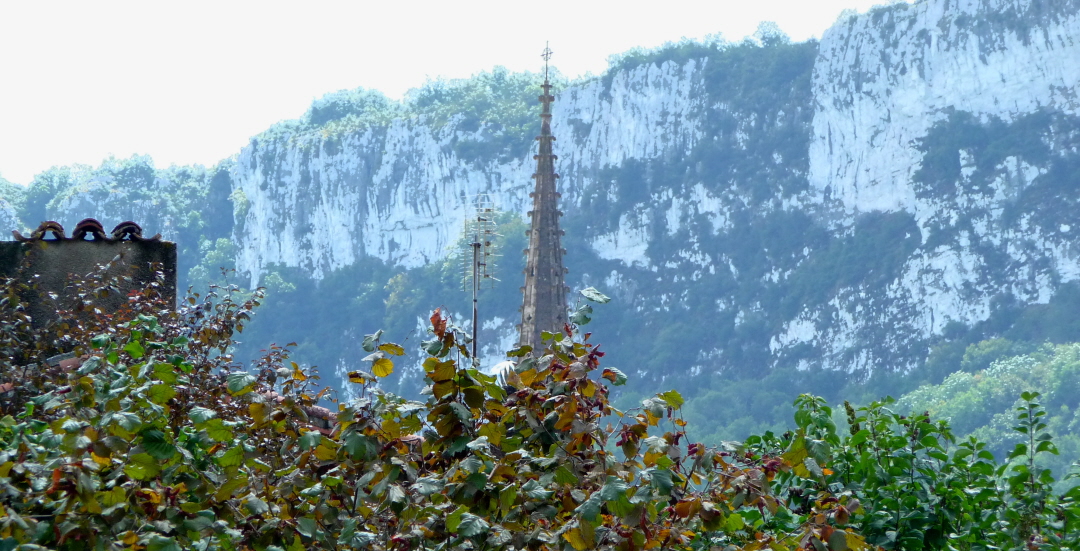
Fortuitously, given I have my heart set on staying within the palace, Malena finds us at the tourist office looking for a room and insists that she has the perfect place for us. She does. I describe it as 'minimalist', or perhaps 'chaste'. Dave prefers 'austere'. The location is perfect. We love the view of the roof tops and the cathedral spire from our window.. We even love the pealing of the bells for mass.

View from our 3rd floor attic room.

Dave thinks that I am such a 'princess' at times that a palace is an appropriate place for me. I can detect a pea under any mattress. I hate being pushed. I dislike queues. And can't sleep unless it is dark and quiet. Yes I would try the patience of any prince, let alone an Old Dog.
The tension between us builds as the temperature and humidity rises in Split. A liner arrives and disgorges its 'humants' into the town centre.

Another princess - 'Crown Princess' a Grand class cruise ship, with 3,080 passengers, viewed from 'Marmontova Ulica'.

The belly dancing concert outside the cathedral jars with the surroundings. 
A black cat gives me the evil eye at a restaurant.

Simple, but illuminating. The lamp geographically differentiates one adjoining restaurant from another

After a guided walk around the city in the morning, I stupidly decide to catch a bus out to the vigorously promoted new shopping centre in an outer suburb. It will be cooler for Dave and I need new clothes. I have put on weight and decide not to fight it, just to wear black. There is no way I can resist the cheese filled breads or cherry strudels or cheap pizzas of Croatia.
After living out of a tiny suitcase for over three months, I hate all of my clothes. Unlike my mother who packs colour co-ordinated clothes, drawing on her skills of selecting harmonious colours for her quilts or gardens or flower arrangements, I have the oddest assortment of garments; the white T-shirt [now grey], the flamboyant pink floral top which seemed so RIGHT in Seville and the flouncy orange skirt , bought after seeing the gypsy performance in Granada, and the baggy ten euro shorts from the market in Collioure, the navy and white striped sailors top from Zadar and my only sleeveless dress, an impulse buy in a supermarket on our last day in France. Unfortunately I didn't try it on but a very old Frenchman next to me said it was “très jolie” and the checkout girl thought it was the right size. Unfortunately it is that clingy material. When I saw a photo of me in it I almost cut it up, [the dress]. The truth is you cannot squeeze an overweight caterpillar shaped body into a tight stretchy brown and cream spotty dress and expect a butterfly to emerge.

This gets me thinking that wherever I am I want to take on the personality of that place. There is something mercurial, even unstable about it. “You are so adaptable,” my best friend Sarah said to me at high school. I thought it was a compliment. Now I wonder if I am deeply flawed. Do I lack a centre, a core? Like Peer Gynt, will I peel off layer after layer of the onion to find at the centre....nothing? I was Carmen in Spain, Occitan Carol in France. Here I am Karina Kolovic, in widow's black, sitting by the sea spinning stories.
Enough of this! Back to the story. We go to the shopping Centre, which is sterile, expensive, with global brands: indistinct from any such place in the world. Annie Lennox sings;
I travel the world and the seven seas
Everybody's looking for something

Some of them want to use you
Some of them want to get used by you
Some of them want to abuse you
Some of them want to be abused

Sweet dreams are made of this...

I leave in a black mood but without a black wardrobe.

As we wait for a bus, the heat is stifling and dark clouds gather on the horizon, a storm brewing. We snarl at each other. By the time we reach the Old Town, the storm has erupted into thunder and lightening. We stop on a balcony cafe for a drink and watch the storm over the sea.

'By the time we reach the Old Town, the storm has erupted...'

We are storming too. Finally we realise that being together for so long in confined spaces and spending so much time together is creating too much static.

Split Harbour.

We start doing separate things during the day, and soon all is calm.

On my own I explore the quiet alleyways, the vine covered courtyards, the tiny Saint Martin's church, the smallest in the world, built inside the city walls, the stalls selling lavender from Hvar, the blue harbour busy with boats and decide that Split is another place which has captured my heart and mind.

In the corridor behind the orange-bricked-up windows exists the 'smallest active church' in the world.

Dave and I stroll along the esplanade, where once the sapphire sea lapped the gleaming white arches of the palace walls.

We wander around to the local beach all gold and bronze in the late afternoon light and watch the locals play chess and cards,

swim and play 'picigin', sunbathe, play instruments and sing, drink beer and have massages.

At the restaurant boasting the 'Croatian chef of the year' we eat tuna and swordfish with 'mangold' and I drink schnapps with the restaurateur. Tomorrow the princess leaves the palace and perhaps the emperor has no clothes. I now have a Split personality.

Wednesday, 29 August 2012

sun sets on zadar


“We have the most beautiful sunsets in the world,” the thin waiter tells me as he delivers my glass of 'maraschino' on ice.
“You do,” I agree, as the blood orange sun slides into the azure Adriatic. Above the scalloped edges of the long island on the horizon, the sun bleeds into the sky, making silhouettes of boats, people and palm trees.
Of course many places in the world have sunsets to die for. [I love Bali sunsets for example], but it is the power of words which gives Zadar the superlative sunset. Alfred Hitchcock's words in this case. It helps if the words are those of a celebrity!
It is our last night here. We plan for two nights and stay for five, such is the allure of this city. Because we haven't pre-booked accommodation and it is August, we have to move three times, from a spacious private room to a hotel room the size of a wardrobe to a studio apartment with walls painted lurid lime and vibrant vermilion.


Luckily in this pedestrianised Old-Town of Zadar, we only pull our bags a couple of hundred metres over shiny flagstones each time we move. It is kind of fun. And a city without cars is every thing I imagined it to be. If only... We don't want to leave this haven which nestles between the old city walls and the sea, but there is so much more to see along the Dalmation coast and only two weeks left to see it.

Architecture, or the initial 'publicity shot' 
for the release of the latest 'Fiat Punto'?

As the sun sets we are eating grilled sea-bass at the restaurant on the esplanade, when a group of eight men at an adjacent table start singing, with rich harmonies, softly at first, then building to full voice. The music is 'Klapa', traditional Croatian songs of love and longing and loss.
I imagine fishermen in their navy and white striped tops sailing around the 1,246 islands of the Dalmation archipelago singing as the sun sets.


Later we see our singers perform at a concert on the esplanade; they were practising over a drink in our restaurant.
When the men stop singing, a group of young women begin tentatively singing sad, haunting songs. Their voices are higher and thinner but strangely mesmerising like the sounds of mermaids which sailors heard at sea.
With the sunset, the songs, the succulent sea-bass, the serene sea, it is hard to imagine a more perfect place to be. Yet the city was repeatedly bombed by the allies during the second world war, so much of it had to be rebuilt. Although the Serbs attacked Zadar during the Civil War, they didn't penetrate the Old Town.
The weather is sublime every night. All the women wear sleeveless dresses or tops. Yes, even I bare my fleshy arms!

The keen observer will have realised Carol does not use a
Canon EOS digital camera.

The entire city is buzzing and bursting with life. People fill every square and alleyway, at tables and chairs or wooden benches. Some promenade or dance to the nightly free music concerts in the central square. Our apartment is in a zone where the men go for beer or spirits with small black coffee [kava] and cigarettes for breakfast. This is near the university, reputedly the first to be built in Croatia in 1396. At night the district transforms itself into a labyrinthine outdoor night club with psychedelic patterns projected onto old stone walls. Here the young and cool chill-out as music thumps out of doorways of bars and clubs. But we don't see any drunk or disorderly behaviour as we head through the zone to reach our apartment at midnight.

Zadar caters for everyone. Families with tiny children dance in the square alongside middle aged couples and the old men still sit in another alleyway and smoke.
Although bustling, Zadar is not overcrowded. I don't feel overwhelmed by the 'humants' we experienced in Plitvicka.
Every day we find more to delight us within Zadar's protective walls. I love the eclectic mix of the old and the new in architecture, music, people and food.


Old women dressed in black with black head-scarves come in by ferry to shop at the fresh produce market alongside barely clad, tanned leggy girls with long lustrous hair and bodies as luscious as the ripe fruit and vegetables stacked on the market stalls.


Children play on Roman ruins next to swanky cafes. Ancient stone pillars appear in the middle of newly paved squares. Shops selling religious icons around the corner from a sex shop with its fetishist icons, including the biggest plastic [?] penis I have ever seen. Women in traditional Croatian folk costumes finish a performance and come to dance to a rock and roll band in the square, waving their head scarves in the air.

Croatian dancing... folk and funk.

We take ferries to two islands. My favourite is Silba, more remote and unspoiled, with an old stone village, fragrant pine trees, a fennel schnapps after lunch and the clearest warmest water for swimming. Silba has twenty unique species of butterfly and claims to be allergy free. There are no cars. People move heavy loads around the island with handcarts. 

Island immersion.

As the car ferry pulls out from the wharf, the sun sets on Silba and the sea darkens to a midnight blue. My eyes are heavy and my skin stings with sun and salt, so I stretch out on a bench on deck for the four hour ferry ride back to Zadar by the light of a thin crescent moon. I swear I can hear the eerie sounds of sad siren songs calling me back to the sea.


Friday, 24 August 2012

plitvicka...when push comes to shove


Our first glimpse of the sublime, clear, cobalt-coloured water of the Plitvicka Lakes

I am at the Plitvicka Lakes, one of the most exquisitely beautiful places in Croatia, and I am distressed and disappointed.
At the end of a long day, I am one of the first people waiting for the bus, which transfers people between locations in the park. The bus arrives, but hundreds of people surge forward, blocking the doorways, and filling the bus before I can climb aboard.

A sullen mouthed woman in a blue uniform says, “No more,” and the doors close. “Excuse me,” I say. “I have have waited over an hour for two buses now and I can't get on because people push in front of me.”
She is unmoved. “That's our rule here,” she says “You push.” Her eyes are insolent.

I am a 63 year old woman, tired from four hours walking around the lakes on a warm day, and there is no way I can push past the 7 foot tall German Heidis with their thick plaits or the groups of athletic young Croatian males. I have never been good in crowds. Dave says he will push for me next time, the way he shielded me in Hong Kong more than 30 years ago when I first experienced a human crush, while catching a ferry. But I won't wait for another 30 minutes and it is getting late so Dave and I walk for nearly two hours to get to the boat to take us across the surreal turquoise lake.

Sometimes emerald green, sometimes turquoise waters 
of the lakes.

On the shore, a tour group of Italians waits for the boat with us. As soon as it moors, an elderly Italian man elbows me out of the way, shoving me in the ribs. By now I am close to tears.
Why are people behaving like this? Our hotel manager nails it. “There are too many people.” She sighs. “The tour groups. Too many people in July and August.”

By listing the Plitvicka Lakes as the number one attraction in Croatia, 'Lonely Planet' has ensured that it will never be lonely. It has been a popular tourist destination since 1951, when it became a national park. UNESCO declared it a world heritage site in 1979.
In 1991 tourism was rudely interrupted by the Civil War which, ironically I reflect, began here when rebel Serbs took over the park as their headquarters. The first casualty, a Croation policeman, occurred here. There is something almost obscene about a war beginning in such a natural paradise.

Tranquillity and peace...

Like so many other people, I came here to commune with nature, to hike around the wondrous system of tiered lakes, cascading streams and waterfalls with their clear waters and forested mountains. I hope to glimpse the wild animals, wolves, deer, bears, boar or lynxes, or at least to feel their shadowy presences in the woods of beech, fir, spruce and flowering ash.

Instead, I see people. Tens of thousands of them. They are crawling in single file along the 18kms of paths and board-walks and narrow footbridges, like ants. I can't go at my own pace or stop to stare. Sometimes I flatten myself against a rock wall and wait for half an hour until there is a little space. Koreans, South Americans, Italians, Chinese and Russians file past. It is hard to even see the lakes, but I can hear waters rushing beneath the board-walk in places.

'Humant' behaviour.

It is more crowded here than at the Alhambra in Spain. There are queues for food, for the boats, for buses. I overhear some young people from Spain and the Netherlands expressing their disappointment. They can't see the lakes or the wild boar. They note the number of Russians with “big bellies and cowboy boots.” They see the Russians in every country they visit. “Just because they have money, they think they have rights.” It is a sensitive time, economically, in Europe and these young university graduates are feeling it.


When we reach a waterfall, I see a steep stairway cut into the rock leading to a lookout high above. To escape the crowds we huff and puff our way to the top to find spectacular views and a forest track with only a few young hikers. The scenery is spectacular and apparently almost unchanged since the last Ice Age.

I know that in every culture there are people who believe in 'dog eat dog', a survival of the fittest mentality, but now that we are rapidly moving towards a one world consciousness, we need to find a more humane and pragmatic set of values. I see a lad wearing a TEAM [Together We Achieve More] slogan on his T-shirt.
I once heard Tim Costello, an Australian social commentator, say that the measure of a society's robustness is the way it treats its frail, elderly and marginal citizens.
Surely there are better ways than 'push and shove.'

Splendid solitude...

We are leaving Plitvicka for the Dalmation coast. A diminutive young Parisienne notary engages us in conversation at the bus stop. Her gentle brown eyes brim with tears as she says, “I don't like this country. The people look unhappy. They won't help you. I don't understand a touristic place being like this.”
She has travelled a lot, particularly in Europe and Asia, but like me, she has sensed something harsh in Plitvicka.


After driving through wooded country, where the trees suggest that summer is morphing into autumn, we pass through a long tunnel cut into the pale limestone hills and reach Zadar, our first coastal destination.
We have entered another world. A Croatia which delights us!

A final reflection...

Friday, 17 August 2012

zagreb


There's a kind of hush all over Zagreb. We notice it from the first day here when we venture out from our Hotel Croatia to explore the city on foot. Even along the six kilometres of Ilica Street, the major road separating the Upper Town from the Lower Town, there is only an occasional car. We pass pedestrians. People on bicycles pass us. Sleek sky blue trams reflecting clouds in their windows quietly glide past every few minutes. Beneath the austere brown buildings lining the street there are many shops, but except for the bread shops and caffe/bars, a lot are closed, giving the street a shabby, deserted appearance.

Another closed local shop.

My map reading skills being what they are, we take a wrong turning and are soon lost on a thickly wooded hillside, where the paths criss-cross each other at confusing angles. There are no signs. We are like Hansel and Gretel lost in the woods, but in the middle of a city of one million, which is about the same size as our home town, Adelaide. Half an hour earlier we passed an old woman walking with a stick and a jogger flashes past between the trees higher up. Zagreb certainly has plenty of parks but where ARE all the people?

We head upwards hoping for an overview of the city and come to an open park with a playground and a kiosk where two teenage girls with earrings in their noses and ears huddle at a table, engrossed in each other. They speak English well and are very happy to point us in the right direction to find the central squares and pedestrianised streets of the city, the centre of Zagreb's renowned lounge culture. We find the cafes with rows upon rows of outdoor tables and chairs filling street after street, but Zagreb seems almost empty compared to other places we have visited like Seville and Granada and Carcassonne. And this is Saturday when most of Zagreb reputedly goes out for coffee and cake and people watching.


Later I read in my Lonely Planet Guide that Zagreb is almost deserted in August when everyone heads for the coast. We see few young people [the students must be on holidays], or families with children; mainly middle aged or elderly Croatians and a sprinkling of German, Italian, French and Spanish tourists. All the young beauties of Zagreb must be sunning themselves on the party islands of the Dalmation coast.
There are handwritten signs on shop doors indicating that the proprietors have gone away until the end of August.
On Sunday a few tour groups, with guides, swell the numbers in the centre and we admire the same sights; some architecturally interesting buildings, the palaces and museums, the cathedral and the iconic Saint Mark's church, the colourful markets under red umbrellas, the pageantry of the Changing of the Guards, the statues and folkloric performances. 

Changing of the Guards

Zagreb boasts many theatres, art galleries and museums, and a packed program of cultural events, but early August is not the best time to visit, particularly when we find everything, even the Botanical Gardens, closed on Wednesday for the Festival of the Virgin.

St Mark's

We learn that Zagreb invented the neck-tie and the fountain pen, both fading in relevance I fear. 
 
We love the museum of naive art with many works depicting scenes of village life in this region. There are a lot worse things to do than to sit in the sun with a cold beer in one of the spacious squares of Zagreb.

Ban Jelacic 1848.

The city revs up a bit during the working week, and the trams are packed when we travel to the residential areas outside the city, to see endless shabby concrete blocks of flats, many spacious recreational parks and matronly women flocking to new shopping centres.
MacDonald’s is turning from red to green. Hot Red Chilli Peppers are performing at the Arena in September. Even Harvey Norman is here. Zagreb is on the move.

On the trams and in the cafes I am struck by how quiet it is here after three months in Spain and southern France. It is not just the time of the year or the relative absence of cars which accounts for the silence.
It is also the language and the way people speak. It is softer and flatter, at times hushed or monotonic. It is the whispering of a sad sea or the soothing voice of a mother calming her child to sleep. Sometimes it is the staccato sound of rapid fire.
The Spanish talk loudly and expressively, laugh, sing, shout and chant. In Madrid the human sounds soared above the sounds of the traffic. The French use language to engage and connect, to joke, to express civility. Particularly in country regions, everyone acknowledges each other with a cheery “Bonjour.” I am eating alone in a cafe and a passer-by wishes me “Bon Appetit” We are farewelled with “Au revoir” or “A bientôt.” The language is a musical stream babbling over rocks.
I loved it when we were in Bouriege listening to children's voices ringing out across the valley as they chanted French rhymes and clapping songs. Wherever you are in France, people acknowledge each other. “D'accord,” “Voila,” “S’il-vous plais madame,” “Mais oui,” “Merci.” Happy sounds.

I know I haven't been here long; I have the naive perceptions of the outsider. Perhaps an outsider, in seeing differently, finds a pattern, a colour or shape to things which the insider may not notice. I wonder how much the language has shaped the culture or vice versa.

Here people sit silently in cafes and chain smoke or talk to each other in subdued tones. There is a melancholic note to the language. Two men at a cafe table communicate in sign language for the deaf. Their non verbal animation seems louder than the conversations at other tables. The manager at our hotel smiles with his eyebrows not his mouth. But the young receptionists have warm smiles and fluent English. I am sure that when the young people return from holidays, Zagreb will resume its new optimistic personality.

A group of women in traditional costumes sing lustily with joy, but many of the old people look ravaged by their lives. I see a number of women with black eyes. There is an exhibition about violence to women on at the gallery of modern art. Women were burnt as witches in the 18th century; domestic violence is an issue here.

I feel increasingly sad as I learn more about the disturbing history of Croatia, the way people here have suffered and the cruelty we are capable of as human beings. Although there are positive signs in this 'new' Croatia, I can't help noticing the poverty and the pain.. Our hotel receptionist is outraged when she hears we have been overcharged by a taxi driver. “I work for two days for that amount,” she says, “and a taxi driver takes that from you in half an hour.” Now she is expressive. We see two men shouting at each other in the middle of the road, in dispute about who was at fault in a near accident. Beneath the silence, perhaps there is a lot of anger and fear.

As we approach the main city square we hear loud live music. A band and young singers belt out 'Proud Mary' in English. There are television cameras and a surging crowd.
A quartet of older male singers, with voices which blend into a single stream of harmonies, mesmerise the crowd with traditional Croatian songs. I notice people waving little Croation flags, or dancing and singing along with the words. The younger pop singers return and sing 'My Way' and 'We are the Champions.' Of course. It is the homecoming ceremony for the Olympic athletes.

The crowd roars when they come on stage. There are speeches. The excitement builds. The men sing more traditional anthems and everyone joins in, young and old. An old man next to me has tears in his eyes. Old women sway their hips in time to these rousing anthems. Young men hug and raise their flags.
The rock band sings 'Stand By Me' and I join in. I feel it. The nationalist pride of a new nation. Croatia. I am one of them for a moment. I want to show the world what we can achieve, despite the turmoil of our recent and more distant past. How easy it is to stir up nationalist sentiments!

The athletes leave the stage and the crowd disperses, but a few stragglers stay to hear the final song.
After the exhilaration comes a sobering reminder of the tragedy of the Civil War in the emotionally charged voice of the pint sized female singer:

I don't wanna talk
About the things we've gone through,
Though it's hurting me
Now it's history
I've played all my cards
And that's what you've done too
Nothing more to say
No more ace to play
The winner takes it all
The loser's standing small
Beside the victory
That's a destiny

 A bearded man, decked out in red and white, lowers his flag. He looks confused. His eyes empty of fervour. The moment is over. He gets on his bike.

Over fresh trout with almonds at the place where they dress like Hansel and Gretel, we talk about being away with different words. We feel rude when we can't respond in Croation. I know Ne is no and Da is yes and Molimo means please. “Bog is hullo” I say. '”I'm not going to say that,” says Old Dog.

I look blankly at the street signs and menus. I notice how many consonants there are in words, particularly V and K and J and Z, with few vowels in between. I look at them and try to hear the sound of the words. But I can't visualise them or make associations unless they resemble words I know.
When I see the word “tram”, I hear it and I see the word and I see various trams and I feel the movement of the old rattling tram to Glenelg and I remember the feeling of excitement when my nanna took me to Adelaide on the tram and the old horse drawn tram to Granite Island .I think about it being a green and effective way to travel in cities. I wish we had more trams and less cars in Adelaide.
The four letters are exploding with meaning. But when I see vrijeme or sljivovica, there are no associations. There's a kind of hush.


Monday, 13 August 2012

bit of a boules up

Our friends invite us to visit Saint Antonin to play pétanque with them in the village competition.
We punch Saint Antonin into the GPS and she comes up with two places. One is in Provence. We choose the other which is west of Toulouse as we know our friends are about 100kms from there.

We couldn't manage driving in France without the GPS. We call her Joyce as she sounds like a gentle well spoken English woman from a BBC program. The kind you could see reporting from the middle east while bombs explode and yet she stays as calm as if describing a royal garden party.
The drive is uneventful until we pass through Toulouse on a spaghetti tangle of big busy roads. “Have you looked at the map on the the screen?” Dave asks. “Yes, but it's doing my head in,” I reply.
Even with Joyce's calm no-nonsense guidance we manage to take one wrong turn. But the beauty of Joyce is that she is implacable and unflappable. “The route is being recalculated,” she announces in a voice devoid of derision or anxiety, and she firmly redirects us through the network of roads which remind me of the Mad Mouse, a sideshow at the Royal Adelaide show which I foolishly rode once with my son.

Eventually we leave the endless apartment blocks behind and see fields of corn and hay and sunflowers from the busy motorway. The country is flat and uninteresting compared to the Aude region where we are staying. Strange, we think, after four hours, as we neared our destination. Our friends said it was spectacular country. Perhaps it changes suddenly.
Finally Joyce directs us to turn off on a narrow road and after 20 kms announces,”You have arrived at your destination.”
Sure enough, there is the sign, Saint Antonin. “But we can't go into the town,” I say. “there is a fete today and we won't be able to get a park, so we have to go straight to the camping ground to meet our friends for lunch and pétanque.”
But we are already in the village. Not a car. Not a person. Three houses One Mairie. No shops. No bars or cafes. Not even an église. I wonder where our Bed and Breakfast is, but before we can blink we are out of the town. We drive around for half an hour looking in vain for a camping ground
Tired and hungry, it slowly dawns on us. We must be in the wrong place!
How is this possible?

Luckily I have brought the French Road Atlas. I check the index. Yes, Joyce was right. Only two 'Saint Antonins' but I notice five 'Saint Antonin-somethings'. Through a process of elimination we choose two possibilities, north east of Toulouse, but one is too far. We choose 'Saint Antonin Noble Val' because it is larger on the map. We phone our friends, they don't answer, so we may travel for another four hours and still not find them.
I have a hell of a headache. Dave is limp with driving and disappointment. Then I find I have lost the money from my purse, probably when we stopped at the boulangerie. We push on. The sky darkens. I see a lightening flash on the horizon. The traffic is horrendous, as the weather worsens.

We see fruit orchards and almond trees and broad rivers. “I think this IS the region,” I say. We reach the town, gloomy in misty rains and heavy skies. There IS a fete with tractors and hundreds of cars clogging the roads as they leave. Everything is sodden. The light is fading fast.
“At least we know it is the right place.” I whimper.
But we can't find the tunnel or the camping ground. We ask a man walking along the road with umbrella and baguette. “Premier a gauche,” he replies. First on the left. We have arrived.
After a fruitless search of the site, we ask the manager who looks through pages of names in her book of registrations. Our friends are not listed.
“Are there any other camping grounds here?” I ask
There are two more. As we approach the first one I see the landmark our friends had mentioned...a stone tunnel through the hillside. And rising up behind it are the white Les Gorges de l' Aveyron.

Les Gorges de l' Aveyron at dusk.

Eventually we find them, exhausted from traumas of their own. There had been such a fierce storm that it had brought down trees and flooded the office of their camping ground. The fete and the pétanque had been washed out. They have been working all day.

The woman from the B&B has just rung them wondering where we are. Perhaps she hasn't kept our room. We rush in to town. All is well. We settle into Numéro Quinze and flop on to the bed. “I wanted an adventure.” I say. Old Dog doesn't even raise one eyelid.
He is dreaming of the Saint Antonin Noble Val pétanque competition tomorrow!

Old Dog swears someone beat him to it.

It is a brighter world in the morning. We chat over breakfast with a charming Swiss couple, who tell us that we were on the roads on the worst weekend for driving in France. It is called 'Black Saturday'. There were traffic jams up to a total of 175kms at the five main 'hot-spots'.

Tractor fête demonstration the day following the storm.

We are enchanted by the mediaeval town when we explore it on foot. If you are ever in the Tarn, 'Saint Antonin Noble Val' is a must to visit.

Saint Antonin Noble Val city-scape.

Dave enjoyed the pétanque competition, despite the butcher's father taking them into the village to a rough, hilly bituminised lane for a game. 'Très difficile'. The Frenchman had heard about the Aussie fiend!

Saint Antonin Noble Val's river bank is an idyllic site for the pétanque competition.

Only small winnings to celebrate but we have a gourmet meal at 'Le Festin de Babette', a riverside restaurant in Saint Antonin, which leaves a very pleasant taste in our mouths.

It is all research...

The highlight of our return journey is a visit to the 'Toulouse-Lautrec musée' in the artist's birthplace, Albi. Outstanding!

Albi has the Lautrec Musée AND much other grandeur to recommend it.