Monday, 11 June 2012

sevilla - flamenco in parentheses

OldDogs... meet and greet
By midweek we are sweltering in Sevilla. Like a mad dog [and her Englishman] we go out walking in 42 degrees. The streets are almost deserted as the locals sensibly stay indoors for siesta. 
We hit on the plan of buying a multi-trip bus ticket and exploring the city by air-conditioned bus, the coolest place to be, so we jump on the first bus that comes along.

Outside of the old city, we pass endless blocks of shabby high-rise apartments. I see broken wooden blinds and a sheet strung between windows to dry. This is seedy Sevilla.
It reminds me of my first view of people living in relative poverty in Hong Kong in the late seventies.
  I feel sad to see about fifty infant children playing in a concrete school yard in the heat. Not a tree or a bush or a piece of play equipment to be seen.

The children look happy and squeal with delight  as they chase a plastic ball around the yard, but it is such a contrast to our well equipped kindergartens in Australia.

Back in the city centre, Sevilla shares her secrets.

I find her in the streets, the markets and bars, the shops and cultural centres in the residential areas. She is melancholy at her core, but also a woman of many moods.
 
In the Plaza Nueva a group of firemen congregate and their spokesperson, a woman, shouts stridently for more pay, while in Plaza Major a group of university students protest that education is a right not a privilege. Sevilla stamps her feet and tosses her head in anger at the state of the economy.
 
She is proud and haughty too. At a local restaurant where an arty looking crowd of students are eating and drinking, we place an order for food and wine. The food doesn't arrive for over two hours, although other patrons who arrive after us are served, and the young waiter ignores us. I realise it is because we are foreigners. There is a growing dislike of us as Sevilla becomes increasingly dependent on tourism.
 
Usually we experience warmth and generosity from Sevilla. The beautician with the tiniest hands who does my nails with such care and gives me a wonderful hand and arm massage, her only English word being "beautiful" when she surveys her handiwork. The waiter who says "Now I am speaking the English" and tries so hard to communicate with us; the family who gesture for me to sit with them at their table at another outdoor concert.


Often she is in a joyous party mood, looking for a fiesta, a jug of sangria and a reason to dance or sing the night away.  A group of mature women get out their flamenco dresses and sing spanish folk songs; what they lack in ability they make up for in enthusiasm.  Young and old get up and dance the Sevilla to a younger group of singers. A Spanish Beatles cover band sings "Shake it up baby" and I find myself doing just that!


 To Sevilla family is sacred. All those "Virgin Mary with child" images!  Bridal shops abound and on Saturdays there are weddings everywhere. People throw rice as the newly weds and their brilliantly coloured entourage emerge from the ceremony. 
 
There are babies and young children everywhere, often three generations out together, sometimes until midnight. Little girls wear pretty dresses and their hair ribbons match the colour of their shoes...red, blue or yellow. I don't hear anyone scold a child. People struggle with pushers on footpaths that are way too narrow, so they try to balance them on two wheels. And I have never seen so many twins. Is it something in the water or the wine?

Because people live in apartments and it is so warm, life is lived out of doors, particularly at night, and it is such a social and communal way of life, so different from Australia suburbia where you are lucky to know your neighbours. I will miss Sevilla's laughter and the buzz of conversation.

We attend a Charo Martin flamenco fusion concert at the local cultural centre and see another side of Sevilla. We seem to be the only tourists there.


Not only is the performance a modern fusion of flamenco, jazz, bossa nova and old Spanish music styles, but it is a serious and satirical self examination. The female dancer comes out in a short black dress and dances in an almost grotesque overtly sexual way and the male dancer follows lifting his coat  and wriggling his bottom, a dramatic expose of what is happening to flamenco and Sevilla. The female dancer comes back, dressed in the white suit and panama hat of the chorro, a reminder of Spain's imperialist past. The singing and playing is wonderful. This is intelligent, self critical Sevilla.

Night and day... waiting

Sunday, 10 June 2012

sevilla struts her stuff

We have come to Sevilla to find flamenco guitar, dancing and singing. So we go to see a performance at the Museo de Baile Flamenco, the world's only flamenco museum, where the flamenco is advertised as "pure", more traditional than the lavish ensemble shows which attract so many tourists.


We are not disappointed. The virtuosic performers; a female singer whose voice is so powerful and full of loss and longing that it sends shivers up my spine; a brilliant guitarist at one with his instrument and the music; a  wiry male dancer with  haughty, almost evil  expression on his face as he stamps his feet and uses his whole body so vigorously that he shakes sweat over the audience in the front row; and a beautiful female dancer whose facial expressions and hand and arm movements communicate the entire range and intensity of human emotions. 
 
I love this passionate music and dance, which has such sadness at its core. 

It has such an interesting history, the product of so many influences, starting perhaps with the Indians who roamed into Europe, the gypsies, the Moors and the Jews.

Like the blues, it has its roots in oppressed rather than ruling classes. 

Like jazz it includes improvisation. 

Most importantly it is fuelled by the rapport which develops between the performers and between them and the audience.Ole!


You can't wander the wriggling streets of Sevilla without coming across the cathedral, its major monument. From the tower, which was once a minaret, there is a good overview of the city. You climb a ramp which was originally for a man on horseback to ascend to call the muslims to prayer. Much easier than walking it as we do.

Horses and carriages line up outside the cathedral, hoping for tourists who want a ride. A pungent smell of horse manure intensifies with the heat of the day.


After a  couple of days, I am frustrated with Seville. She has flamenco and a cathedral and a bullring and hundreds of tapas bars and many plazas and churches and the same river which flowed through Cordoba.


Egyptillogical levitation.
But she is playing to the tourists.  I can't find the essence of Sevilla. There was a hint of it in the flamenco performance, but even there the tourists were packed in to the "intimate " venue and were more interested in capturing the visuals with their digitals than in deeply entering in to the experience. [Poor Dave. I gave him strict instructions to keep the photography to a minimum.]


So, over the next few days we avoid Sevilla's 'attractions ' and set off in search of her "duende", her true spirit.

Friday, 8 June 2012

sevilla....the stage is set for flamenco

Seville's Metropol Parasol, or The 'Mushrooms of Incarnation', located in Plaza de la Encarnacion, at a cost an eye-watering 90 million euros, is officially the world's largest wooden structure.
It takes less than two hours by train from Cordoba to Seville, but the temperature jumps by at least ten degrees. It may be hot outside but the senora in the tourist information centre at the Santa Justa station responds icily  to our request for a map.
 
This is followed by a chaotic journey through a tangled web of narrow one way streets with an impatient taxi driver. He scowls, disappointed with our tip, when he unloads our luggage in front of the small, historic Hotel Abril.   But the hotel receptionist is welcoming. And she can speak English.


This is another two star hotel, but it has a fridge in the room. Luxury! For 5 euros each, we eat buffet breakfasts in a tiny dining room, which is crammed with tables and chairs; to move from your table to the coffee machine or buffet involves such complicated manoeuvres that it looks as if the guests are dancers or toreadors as they circle and turn and criss-cross the room.

Out in the streets the routes are similarly circuitous. Maps are useless. There is no logic to the layout, and a twist in the road, a wrong turn, another plaza to cross, and we are lost again. After the first day we toss the map away and just roam until I internalise the spatial layout of the city. Soon we can be lost and I can navigate my way back, not by street names or by recognising landmarks but through some kind of homing instinct. I must have been a pigeon in a previous life.

On our first night in Sevilla, we wander out from the hotel, only to find that we are just around the corner from the Plaza Mayor with its anachronistic latticed artwork, the "mushroom", arching over it.
We stop for tapas and see a group of young girls dressed in flamenco costumes in the plaza. Musicians carrying instruments gather nearby.
So we grab a table and a couple of chairs in front of a temporary stage in the centre of the square and buy a bottle of the local regional manzanilla, "La Guita", a kind of dry white sherry, which tastes of apples and turpentine.
We are treated to an evening of la musica d' Espanol a free concert by the  local municipal symphony orchestra.


The "flamenco" girls carry baskets, smile at us and hand us white carnations. 

A Spanish man joins us at our table and tries to converse with me. He tells me that the music is Paso Doble, pushes a carnation behind my ear and gestures for me to dance with him. His wife and grandson appear. From her stern looks I gather that he fancies himself as a Don Juan.

With the warm night, the drama of the music, the manzanilla, the family groups laughing and chattering, the paper lanterns strung from the trees, my spirits soar. 

The city seemed cold at first, but now she is flirting with us, full of promise. 
 

Sunday, 3 June 2012

cordoba and all that jazz

Exhausted from a week in Madrid, we set out somewhat reluctantly to see La Mezquita, a weird combination of Muslim mosque and Catholic cathedral. On the way to Cordoba on the train, I had read about the building's history in Kelly Lipscomb's comprehensive guide book on Spain, which, in my opinion, beats the others hands down .
In a nutshell, the Moors started the mosque in 784AD, on the site of a former Visigothic church, which was built on the site of a former Roman temple. The building grew and evolved, until it became a cathedral when the Christians reclaimed Cordoba after four centuries of Moorish rule. Cordoba was once the intellectual centre of Islam.


Christian, Jewish and Muslim stonemasons left their marks on the walls and columns throughout the mosque, so it is not only modern day bloggers who need to say, 
" I was here. This is what I did."

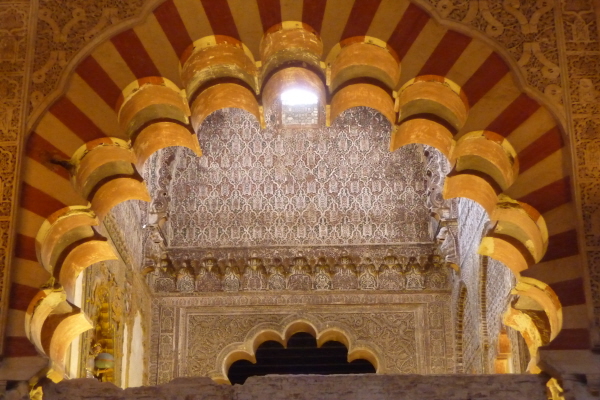
I was struck by the clash of styles in the building which combines Islamic, Mudeja, Renaissance and Baroque elements in a jarring yet awe inspiring mix.
The endless red and white arches seem to suggest infinity, while the opulence of the cathedral built in the middle , suggests power and wealth. But these days only a small group of elderly parishioners attends the mass.


Nothing I had read prepared me for the impact La Mezquita had on me.
We arrived early in the morning, when the place was almost empty, before the tour groups arrived. Soulful, sonorous sounds of the pipe organ filled the cavernous spaces, illuminated by the morning light.
I felt a growing sense of reverence as I thought of the human beings who for centuries had worshipped, prayed, chanted, sang, knelt, prostrated themselves on this site. I could almost feel their presence as I walked over the cold marble floor, each slab the size of a prayer mat.
Suddenly I felt my eyes fill with tears and I was overcome with emotion, a most unexpected reaction from a pagan like me. I could have converted on the spot. But to what?
I guess that is the effect these buildings are designed to have on us of little faith.

I preferred the simplicity of the Islamic elements, but overall the fusion worked for me. It was emblematic of the way that all cultures influence each other. and that at whatever point we find ourselves in the human story, we are part of a continuum, stretching back to before we could write that story and when images were lines in the sand or on the walls of caves.

Out on the streets...


Irrigating the orange trees


Spanish guitar music in the street


Roman bridge over the Rio Gualdalquieir


Patios...

From the outside, the medieval buildings, which line the narrow streets look very plain. But many of them have indoor courtyards, green oases with fountains, flowers, mosaic patterns with tiles or pebbles and in one, birds singing. 


Personally...

Lamb with saffron rice and chicken tagine..


Carol succumbs to the touristy shops in the Jewish quarter.


 Swinging singing violin
Our final night in Cordoba was magical. Walking through a park we stopped for an 8pm sangria at a cafe, which extended into dinner with a packed crowd of locals [not a free table in the house] and an amazing jazz band. I still can't believe that families with very young children turn up at 11pm for the evening meal.  Oh what a night! 

On a more melancholy note.......

 Cordoba, distant and lonely,
Black pony, large moon,
In my saddlebag olives,
Well as I know the roads,
I shall never reach Cordoba,
Over the plain, through the wind,
Black pony, red moon.
Death keeps a watch on me,
From Cordoba's towers.
Oh, such a long way to go,
And oh, my spirited pony.
 Oh but death awaits me,
Before I ever reach Cordoba.

Frederico Garcia Lorca, Rider's Song